Nature Tips #2 Cyan, Cobalt blue, and You messing with the Hue

<!-- /* Font Definitions */ @font-face {font-family:"Times New Roman"; panose-1:0 2 2 6 3 5 4 5 2 3; mso-font-charset:0; mso-generic-font-family:auto; mso-font-pitch:variable; mso-font-signature:50331648 0 0 0 1 0;} /* Style Definitions */ p.MsoNormal, li.MsoNormal, div.MsoNormal {mso-style-parent:""; margin:0in; margin-bottom:.0001pt; mso-pagination:widow-orphan; font-size:12.0pt; font-family:"Times New Roman";} table.MsoNormalTable {mso-style-parent:""; font-size:10.0pt; font-family:"Times New Roman";} @page Section1 {size:8.5in 11.0in; margin:1.0in 1.25in 1.0in 1.25in; mso-header-margin:.5in; mso-footer-margin:.5in; mso-paper-source:0;} div.Section1 {page:Section1;} -->

A quick and easy trick to make your skies more aesthetic:
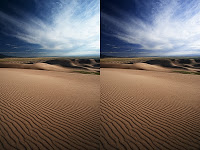
You may notice in some images the most amazing blue skies and you are not quite sure what it is about them that is so appealing. In some cases, it is lack of cyan. While this will not be a universal tip for skies, it works in many cases, particularly when you are creating darker images.

When you darken a sky in Photoshop, especially when using luminosity masking, you will get these kind of muddy dull cyan colors mixed in with the brighter areas of the sky, particularly when the sky is filtered by clouds and horizon haze. To fix this, open up a hue and saturation adjustment layer. Select Cyan from the menu and then move hue to the right until you have the desired sky. Then mask out the rest of the image to preserve the color balance you achieved on the raw import. A quick little fix like that can make or break an image.
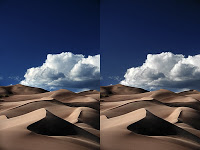
Similarly this can be done when you have large bodies of clouds. In these cases I find simply de-saturating the cyan out of the clouds gives a better cloud color. Keep in mind when you are removing this cyan, what you are doing is creating an image that is closer to what we on some level believe it ought to look like. Clouds are black and white with shades of gray. Skies are a Parrish or cobalt blue. Similar things can be done with yellows to greens, though the adjustments are often more slight.

The point of this tip is to bring to attention the power of targeted hue adjustment. In the example images consider that sand is orange and the sky is blue which are complementary colors. If the sand was more yellow, I would consider targeting it to make more orange or targeting the sky to make it more magenta. This is applying basic but effective color theory to a static environment.

Next:

Shooting the Sun

Nature Tips #1 CPL – Circular Polarizer Lens Filter

This one is pretty basic. If you are going to be out shooting in nature, this is your single greatest tool.

Effects

What a CPL does is remove unattractive reflected or glare light. When light becomes reflected from a surface, it becomes polarized. By rotating the filter, you can block this light. This is how photographers remove reflections off of water, give foliage a more saturated feel, and create deep graduated skies.

reflection removal

In the example of the water running over the rocks you can distinctly see the effects of a CPL. Keep in mind that a CPL when set to block reflections reduced on average one stop of light.  Both of the images were shot at the same settings at show this loss of light in addition to removal of reflection.

wedges

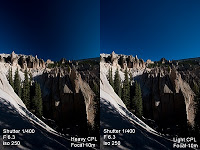
The CPL darkens the sky creating a strong and apparent graduation of tone (which is not only aesthetically pleasing, but can help create the illusion of a greater dynamic range) but this can be drawback in some cases, especially when shooting with a wide lens. In the example image you can see that the CPL creates a giant unpleasant wedge shape of tone in the sky.  The wedge becomes apparent at wider angles.  Keep in mind though, the angle of the graduation of tone is related to where the sun is in relation you. In the image the sun is rising and I am shooting the northeast. If I had been facing west, the sky graduation would go up and down and not an angle.

There are other drawbacks to using CPL, but they can be ameliorated somewhat by simply buying a nicer CPL. The problems will always be there, but the higher quality filters will suffer from it less and in less conditions. Cheaper filters can cause your images to be slightly blurry.

flare

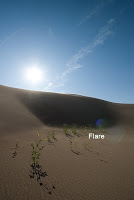
The worst problems appear when the sun shines directly onto your filter. Two things can happen; contrast loss and flare. When the sun shines onto your lens some of it is reflected off the filter, washing out the image. When the sun hits imperfections and the like or becomes split, it can flare. See the example image for flare. More expensive filters try to prevent this with different coatings and lens materials. Keep in mind that is may not be just the filter causing this, but the lens itself. Lenses like filters suffer from these problems.

Flare and contrast can be fixed in photoshop, but its better to get it right before hand. Every edit you make degrades the image slightly. Another two edits can make or break a sky from being a nice gradient to a banded mess of garbage.

A rare but terrible problem that can happen is when light reflected off the lens itself on the filter becomes strong enough to be visible in the image. This occurs under very certain conditions. I have only had it happen to me with CPL a handful of times out of the 20,000 or so shots I have made up to this point.

The bottom line is, buy a CPL as a tool it is essential for photographing nature even with its drawbacks and problems.

All the images presented with this are unedited raw images resized and labeled

Next will be Cyan, Cobalt blue, and You messing with the Hue

Further Examples

reflection removal

reflection removal

Indian Peaks

Indian Peaks is an excellent location located just south of Rocky Mountain National Park. While the park lacks the large sweeping valleys, it contains much of the same high mountain beauty that you can find in the longer hikes of RMNP. The mountains loom over you once you get far enough giving you the same kind of feel you can find on your way up to Chasm lake, but almost more scenic. As you approach Blue Lake, you pass many smaller calm crystal clea

r ponds and great piles of boulders littered with strange spiders that bounce in their web. Throughout the trails are numerous wildflowers that gather around the many streams leading to the ponds. Morning light can make these locations glow, but only if you brave the numerous mosquitoes that sometimes fill the lower parts of the trail.

Indian Peaks unfortunately becomes rather inaccessible during the winter months. A gate closes with the first serious snow fall, which extends round hikes by approximately 3 miles. Coupled with the snow it makes hiking there in the winter tiring. Further complicating winter hiking is that the three times I have been there during the winter, I experienced white out blizzard conditions. Like all high mountain locations, weather can be unpredictable but such hikes can be particularly rewarding emotionally. The gate tends to open in late May and closes in September or October.

In the summer, The Blue Lake Trail or the Mitchell Lake trail are relaxing and rewarding afternoon hikes. Expect ice to vary amounts all year around. When I was there in late July standing snow was still present as well as glacial ice and floating ice in Blue Lake. With the ice and blue co

lor Blue Lake is the gem of the park. Various small water falls feed it surrounded by purple and pale yellow flowers and rather tame marmots and mountain grouse can be found near its edge.

During the summer months, park can be busy, especially on the weekends but no exclusively. Come early both for the better light and so you can even find a spot to park while avoiding the crowds. Parking is rather limited, so even when the park is full, once you are out on the trails it does not seem crowded. You are aware of other people, but it is not the point where you feel like a touron standing at the side of the road in RMNP watching elk. Most people stay near Long Lake to camp, fish, and picnic leaving the trails for people who will appreciate them. If you choose to go in the winter, you will likely need to pick up a day pass in a nearby town that is authorized to sell them. They do not sell passes at the park gate during the winter. I do not know if you need a pass in the winter, I have a universal state park pass so I never looked into it.

For more photos of the area, refer to:

my flickr