A reflection of twelve photos, one from each month, taken over the last year.
January
While I was in school at Regis I always offered to take other photographers in class with me on my hikes, Chris was the first one to accept in my last semester. None of them were ever interested in shooting landscapes but mostly shot street or portraits. So here we are, first or second time out together up in Rocky Mountain National Park and a blizzard (as usual) blows in on the higher lake set. To his credit, he stuck it out with me as we hiked up higher. When we got out onto Dream Lake I stopped to try to work with edge of ice formed from melting and freezing in the wind. Sure enough Chris walks right out into my frame and it's so windy he can't here me yell. On impulse I take a few with him in it and when I get home it made the shot. Without him in the frame the shot is mediocre at best. What makes the shot even better is when you find that Chris is Hawaiian native
.

February
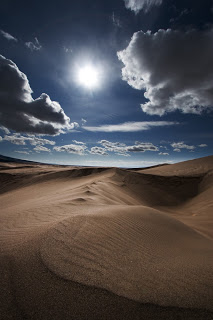
This shot is from what was going to be bromeet of photographers who had met on-line, but two of the other photographers bailed on
and me so again it was just two us. I love Great Sand Dunes National Park, I really do, and on this day it was in particularly good form. Frozen ice and snow under wind driven sand really gave it a deepness of color and texture that worked and the clouds decided to be heavenly for us. I took this shot using Alex's 3 stop hard edge GND (first time using a gnd) and knew I had gold one even before I checked the lcd for the exposure. Luckily I realized before taking this shot that I had left my 30D up at 3200iso from the last time I went shooting at night but not before I had already taken 70 or so shots. There's some great shots lost to image noise from this trip.
March
Shot mostly for school otherwise I probably would've been playing WoW or something at the time. I always seem to have trouble shooting this location (El Dorado Canyon) and this isn't quite the best one I have gotten from the place, but it is the best non-blizzard shot of the area. It's so narrow that it's hard to work with the light that it gets.

April
This is from another trip out with Alex Burke, this time out to the Pawnee Buttes. It was shot from south of the parking lot for the trail out the buttes. When you're standing there the beauty of the place is somewhat marred by these stupid windmills. All the way up to the mountains nearly and then as far as the eye can see to the east is a wall of them that loops around the park jarring the landscape. I've never really cared for these things and they worry me a little. I fear they'll end up doing what other things like this has. They always said that rivers were too big to be effected by the dams all that much, that the fisheries of the ocean too numerous to be depleted, and atmosphere to large to be effected (ozone layer) but each time it hasn't been the case. I worry that with enough of these things out there we'll end up taking too much energy out of the wind systems and screw something up. I actually talked to a pair of scientists at Creighton U that are working on renewable energy and they gave me a rather dismaying answer, that the wind systems were too vast and powerful to be really effected by these things.

May
I have a lot of photos from May. I went out for the third time with a camera to my ancestral home of Long Island Maine. My Grandmother rents out a house she owns from her parents there and each spring she goes out to open it up, I went with this time worried about her in her age. Each time I go out I am struck by the amount of death I find on the beaches. The first time out I found a striking set of wings washed up a beach, a dead and eyeless seal, the skin of a cat, and other macabre findings and this last time was no different. This round I found dead dear parts, this striking snail, and strange vertebrae washed onto the beach. I found this snail in a cove I struggled with to get a good landscape from (a struggle that was ultimately in vain) and I was delighted with it. It was the snail that produced the delightful and hard to find shells that I loved to find on the beach. It's foot was still intact and the flies had already found it, how could I not shoot it? I've got this one printed off my room now.

June
This is from the second time I was up in a plane flown by long time friend Ted Manos. Over last summer he frantically built up hours to get his next level of flight license and often I went along to keep him company. He was flying some tiny Cessna of one kind or another but more importantly you could open the windows. There really isn't anything like shooting a sunset over the Platte River with your head stuck out a plane.

July
Originally Ted and I were going to go flying again but an incoming storm prevented us. Camera in hand along with the car wheel I dragged Ted around rural Nebraska outside of Fremont to work with the scattering clouds from the storm.
Since then, for whatever reason, Ted has started accompanying me outings, sometimes bringing an old Canon a-1 to take shots of his own.

August
From a cross country with instructor flight with Ted. We flew across half of Nebraska or so, away from a developing storm in Iowa. It was fascinating to watch from a plane, the clouds just rise and billow growing mysteriously and continuously in mass. As they grew they were hit by the striking colors of the setting sun from west.

September
Found this guy out the front of my house while doing yard work. He's a swallowtail butterfly larva. I identified him by realizing he looked like the poke'mon Caterpie and then looked up what it was based on. The strange orange horn would emerge when threatened and stank like sulfur, it was very strange.

October
Taken north of Omaha near what would be 72nd street. First time my friend Ted brought a camera along.
November
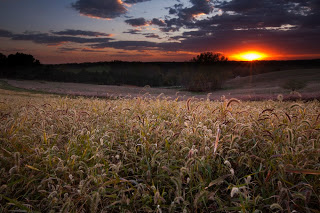
This is from day 2 of a three day shoot at Hitchcock Nature in Iowa. The strange mist and color are a result of smoke from the fires they lit. As part of a prescribed burn they lit the whole place fire which let me tell you is a photographers paradise. Ignoring the incredible color from the smoke and setting sun, the setting is just so much fun. Small fires appear and burn out in the grass while trees (not these ones mind you) would glow with burning embers. Crackling and crashes could be heard as you stood still as burning trees fell. I had to cut this trip short unfortunately, the smoke eventually started to become too much for me.

December
This a farmers field from a trip out to Hitchcock during a particularly nasty blizzard. I don't know why I always feel compelled to go out these stupid things but I do. It was bitterly cold with a strong gusty wind making it impossible to do anything towards it. It was bad enough the I had to leave Hitchcock early. The wind blow ice encrusted my tripod, camera controls, and glasses making taking photos mostly impossible. Such are blizzards.